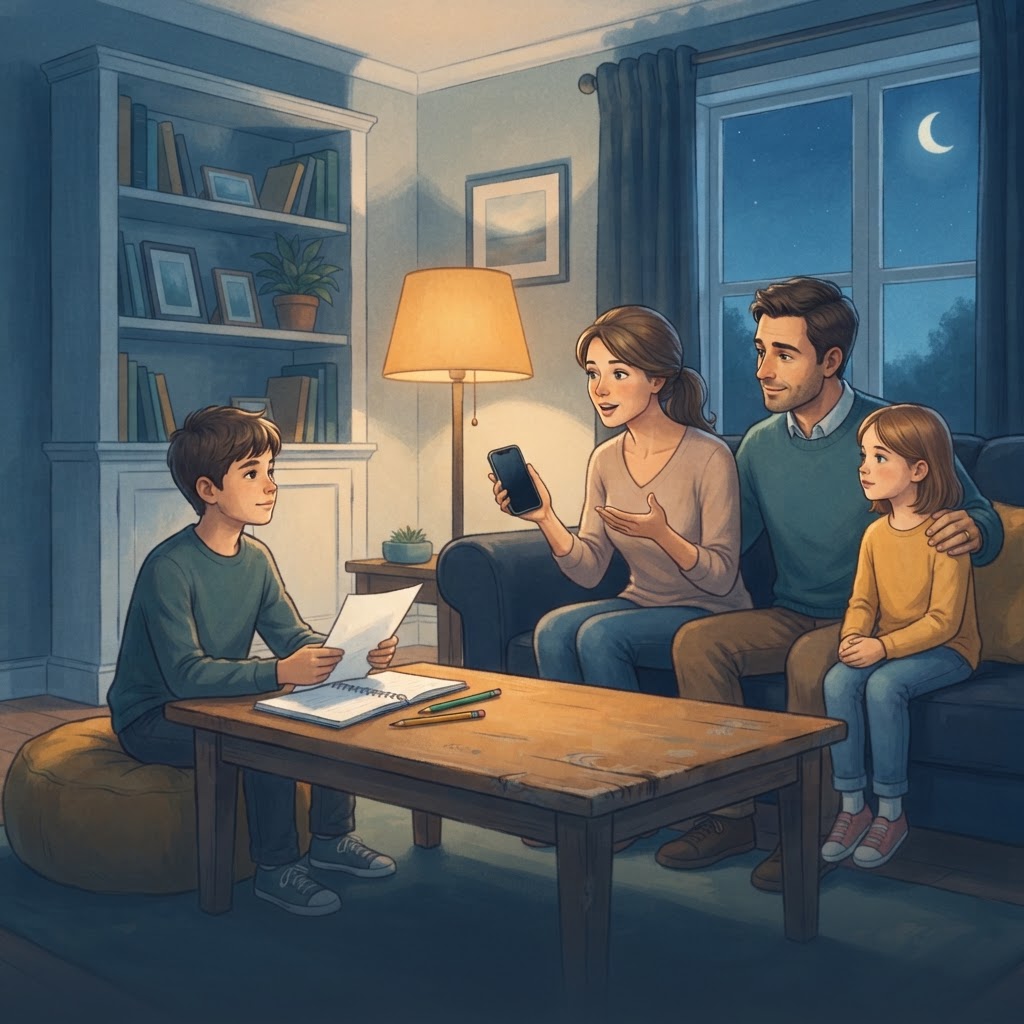
Parents usually frame this question as an age problem. Pick a number, wait until the birthday, hand over the phone. The trouble is that two eleven-year-olds can be in completely different places when it comes to handling a connected device, and two fourteen-year-olds can be just as far apart. Age is a rough proxy at best.
The pressure from both directions is real. On one side: "everyone already has one, he is the only kid without a phone." On the other: blanket advice to hold off until high school because smartphones are harmful. Neither position is wrong exactly, but neither one accounts for your specific child in your specific family. What actually matters is what you can observe in ordinary weeks, before any phone enters the picture.
The signs a child is ready for their first iPhone are not dramatic. They show up in small, unremarkable moments — and once you know what to look for, you will probably have your answer within a week or two of paying attention.
Four Everyday Behaviours That Predict a Workable First Phone
These are not tests to run. They are patterns you can notice without engineering any situation.
They manage something that belongs to them. It does not need to be expensive. A library book that comes back on time, a water bottle that travels to school and back, a game controller that does not live under the couch indefinitely. The specific object does not matter. What you are watching for is whether your child treats things they are responsible for differently from things that belong to everyone. A phone is a personal device, and that relationship needs a foundation.
They tolerate a "no" without a prolonged meltdown. Not gracefully, necessarily — grace is optional at this age. But if a decision does not go their way, can they absorb it and move on within a reasonable amount of time? Limits are going to be part of phone ownership from day one. Screen Time settings, content filters, bedtime lockouts — these will produce friction. A child who can hear "no" and eventually accept it is in a much better position than one who treats every boundary as a negotiation that must be won.
They tell you about problems before the problems get big. This one is easy to overlook. Think back over the last few months: when something went sideways at school, with a friend, in a game, online — did your child bring it to you, or did you find out later by accident? A child who stays quiet until a small thing becomes a large thing is going to have a harder time asking for help when something uncomfortable happens on a phone. That comfort with coming to you matters more than almost anything else.
They can occupy themselves without being handed something. Not all the time, and not for hours. But can your child sit with mild boredom for fifteen minutes and find their own way through it? A phone is very good at filling every gap. A child who has never developed any tolerance for unstructured time is likely to find a phone overwhelming in a way that is hard to walk back.
The Signs Parents Mistake for Readiness
A few things look like readiness and are not.
Wanting the phone badly. Motivation is not a readiness indicator. A child can want something intensely and still not be in a position to handle it well. Wanting is easy.
Being responsible at school. School is a structured environment with external accountability. The discipline a child shows in that setting does not automatically transfer to an unstructured, mostly private device. The two environments are genuinely different.
Having older siblings who managed fine. Siblings are different people. Treat each child as the specific person they are.
All their friends having phones. Social pressure is real and worth taking seriously as a factor in your child's daily life — but it describes the environment, not your child's readiness.
What Readiness Does Not Include (and Why That Is Fine)
Readiness does not mean your child will never make a bad call. They will stumble — share something they should not have, stay up too late, find content you would rather they had not seen. That is not a readiness failure. That is what parental controls and ongoing conversation are for.
It also does not mean your child needs to have a perfect relationship with screens before they get a phone. If your child already watches too much YouTube on the family iPad, the answer is not to fix that completely before moving on. The answer is to set up the phone thoughtfully from the start and do the groundwork before you hand it over.
Readiness is a threshold, not a destination. You are looking for enough — enough self-regulation, enough communication, enough basic care for belongings — to give the guardrails a reasonable chance of working.
A Trial Run That Costs Nothing: A Week With a Borrowed Device
If you are genuinely unsure, this is worth doing. Borrow an old iPhone from a family member or friend — it does not need a SIM card or an active plan to work on Wi-Fi. Load it with a few apps your child would actually want to use. Set a daily time limit using Screen Time (the built-in parental control system on iPhones). Then hand it over for a week and watch.
You are not watching to catch them doing something wrong. You are watching how they handle the transition between phone time and not-phone-time, whether they mention anything that happened on the device, and whether the phone starts appearing in places you agreed it would not be — meals, bedtime, homework. Apparently, five more minutes of YouTube can last until tomorrow morning, so the bedtime observation tends to be the most informative one.
After the week, have a plain conversation about what you both noticed. That conversation is itself a data point. How your child talks about the trial — defensively, openly, with some self-awareness — tells you a lot about how the real thing would go.
If you decide to move forward, a first iPhone checklist for parents can help you make sure nothing important gets skipped before the device goes into your child's hands.
If the Answer Is Not Yet, What to Do Instead
Not yet is a reasonable answer, and it does not need a lengthy justification. Here is what makes the waiting period useful rather than just a countdown.
Give your child supervised access to a shared device on a schedule they know in advance. Predictability helps. If they know they get forty-five minutes after school, the lobbying for more tends to drop.
Work explicitly on the behaviours that felt thin during your assessment. If the issue was coming to you with problems, make a habit of low-stakes check-ins so that channel stays open. If it was object responsibility, pick something small and track it together.
Be honest about what you are watching for. Not as a threat, but as information. "When I see you handling X more consistently, that is going to change how I think about the phone question." Children respond better to a moving target they can see than to a wall with no explanation.
And when the time does come, setting up the iPhone properly from the start makes a bigger difference than most parents expect. The setup is where the guardrails actually get built.